Architecture
kube-oidc-proxy is a reverse proxy that sits in front of a Kubernetes API
server. It authenticates the bearer token on each request against one or more
OIDC issuers, then forwards the request to the API server using
impersonation
headers derived from the token’s claims. The API server sees the request as the
mapped user; RBAC is evaluated for that user as usual.
Because the proxy performs authentication itself, you get OIDC login without
touching the API server’s --oidc-* flags — exactly the knobs you can’t reach
on a managed control plane (EKS, GKE, AKS, …).
- Request flow
- The auth → impersonate handler chain
- Multi-issuer union authenticator
- Readiness semantics
- Diagrams
- See also
Request flow
Section titled “Request flow”- A client (
kubectl) sends a request over HTTPS, carrying an OIDC ID token as a bearer token. - The proxy validates the JWT against the configured issuer(s): it fetches and caches each issuer’s JWKS, then verifies the signature, issuer, audience, expiry, and any required claims.
- On success, the proxy maps the token’s claims to a Kubernetes identity — username, groups, and extra info — applying any configured prefixes.
- The proxy forwards the original request to the kube-apiserver,
authenticating with its own ServiceAccount and attaching
Impersonate-User/Impersonate-Group/Impersonate-Extra-*headers for the mapped identity. - The API server evaluates RBAC for the impersonated identity and returns the response, which the proxy passes back to the client.
sequenceDiagram
    autonumber
    participant U as kubectl (user)
    participant P as kube-oidc-proxy
    participant J as OIDC issuer (JWKS)
    participant A as kube-apiserver
    participant R as RBAC

    U->>P: HTTPS request + Bearer ID token
    P->>J: Fetch JWKS / discovery (cached)
    J-->>P: Signing keys
    P->>P: Validate JWT<br/>(issuer, audience, signature, claims)
    Note over P: Map claims → username, groups, extra
    P->>A: Forward request as proxy ServiceAccount<br/>+ Impersonate-User / -Group / -Extra headers
    A->>R: Authorize impersonated identity
    R-->>A: Allow / Deny
    A-->>P: API response
    P-->>U: API response
The auth → impersonate handler chain
Section titled “The auth → impersonate handler chain”Every request passes through the same pipeline:
- Authenticate. The bearer token is validated. If it fails OIDC validation
and token passthrough is enabled, the proxy falls back to a
TokenReviewagainst the API server (see token passthrough). Review results are served from a bounded in-memory cache — see Caching and API-server protection. - Resolve the impersonation target. If the inbound request also carries
Impersonate-*headers (kubectl --as), the proxy runs aSubjectAccessReviewto confirm the authenticated user may assume that identity before honouring it (see the impersonation model). The header value count is capped up front (over-cap requests are rejected with HTTP 431 before any review is sent), and decisions are served from a bounded in-memory cache — see Caching and API-server protection. - Impersonate. The proxy rewrites the request to authenticate as its own
ServiceAccount, attaches the impersonation headers for the resolved identity,
and records the original caller in
originaluser.jetstack.io-*extra headers for the API server’s audit log. - Proxy. The request is streamed to the API server and the response streamed back.
Multi-issuer union authenticator
Section titled “Multi-issuer union authenticator”Single-issuer mode uses the familiar --oidc-* flags and trusts exactly one
issuer. Multi-issuer mode (--authentication-config) loads a Kubernetes
AuthenticationConfiguration that lists several JWT
issuers, each with its own audiences and claim mappings.
The proxy builds one authenticator per issuer and combines them into a union authenticator: an incoming token is offered to each issuer’s authenticator in turn, and the first one that accepts it wins. This is what lets a single proxy accept, for example, tokens from your corporate IdP and from GitHub Actions’ OIDC issuer at the same time. Per-issuer username/group prefixes keep identities from different issuers from colliding.
The two modes are mutually exclusive. When --authentication-config is set,
issuer-specific --oidc-* flags are rejected. The optional OIDC TLS client
certificate/key pair is transport configuration shared by all issuers and is
therefore accepted in either mode.
Readiness semantics
Section titled “Readiness semantics”Each issuer must fetch its JWKS before it can validate tokens. By default the
pod is Ready as soon as at least one issuer has, so one identity provider’s
outage cannot block a rollout for every other system; still-pending issuers
keep initializing in the background and their tokens fail with 401 until they
do. --readiness-require-all-issuers waits for every issuer instead.
Configuration errors always fail startup, regardless of the flag. The details,
the log records that show each issuer’s state, and what happens when an issuer
goes away after startup are in
multi-issuer: readiness and
operations: availability and issuer outages.
Diagrams
Section titled “Diagrams”These C4 model views zoom in from the system in its environment down to the request-handling components. For the runtime view of a single request, see Request flow above.
The diagrams are generated from a Structurizr model; how to edit and re-render them is in development.
System context (C4 level 1)
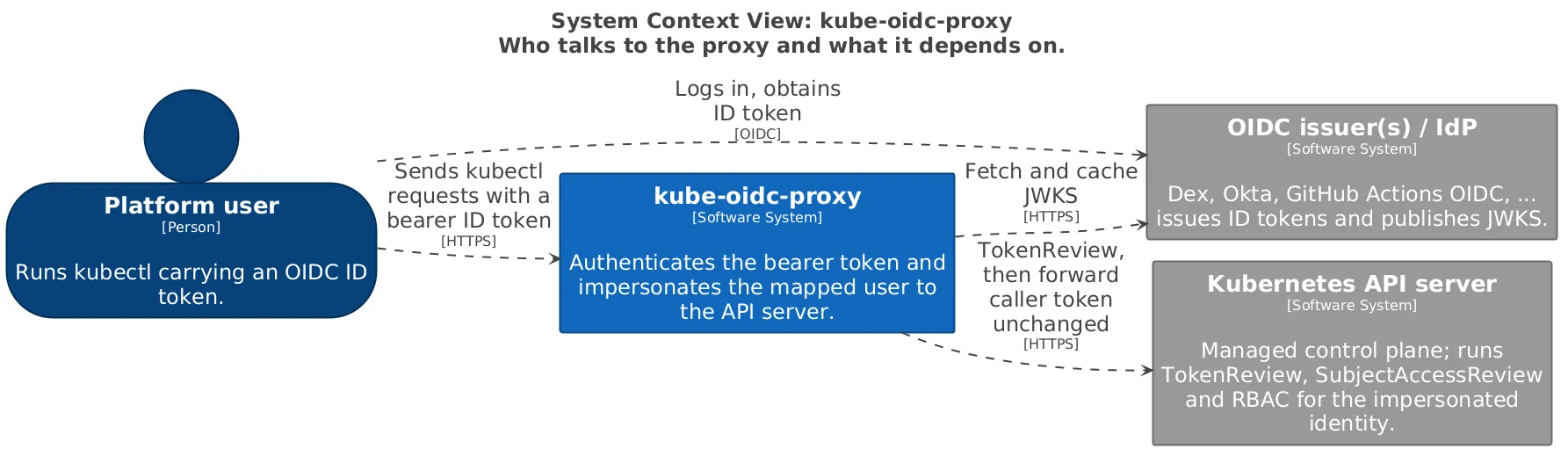
Section titled “System context (C4 level 1)”Who talks to the proxy and what it depends on: the user’s kubectl presents an
ID token, the proxy verifies it against the external OIDC issuer(s), and then
impersonates the mapped user to the external Kubernetes API server.
Containers (C4 level 2)
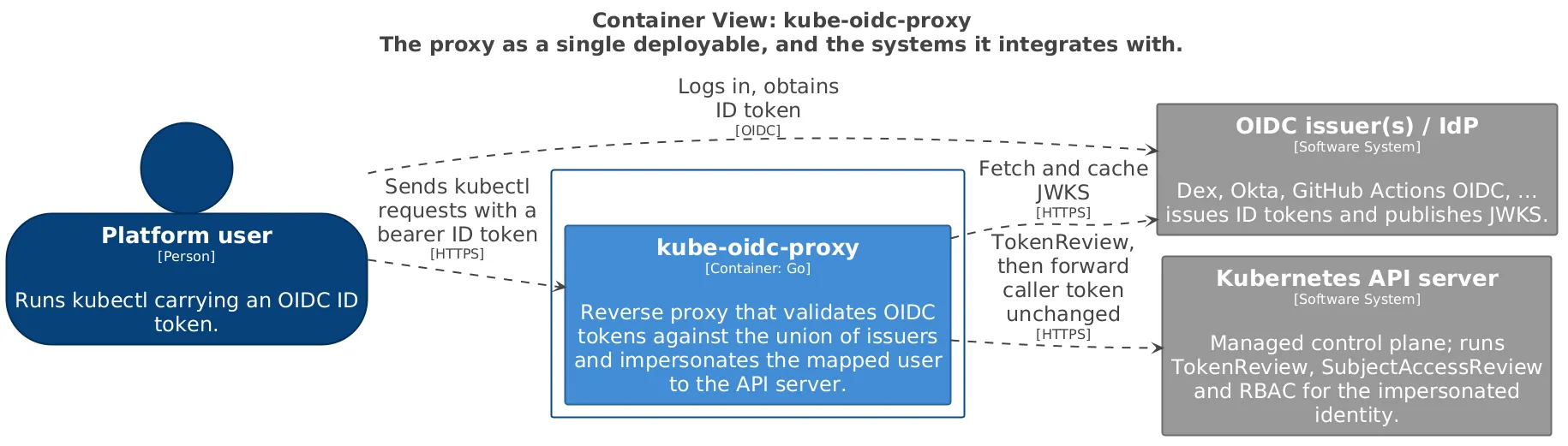
Section titled “Containers (C4 level 2)”Inside the proxy: TLS is terminated by the serving layer, which drives the
handler chain. The authenticator validates the token against the union of
issuers; a token-passthrough fallback and the inbound---as check both consult
the API server, and the readiness probe watches each issuer’s JWKS
initialization through the authenticator.
Handler-chain components (C4 level 3)
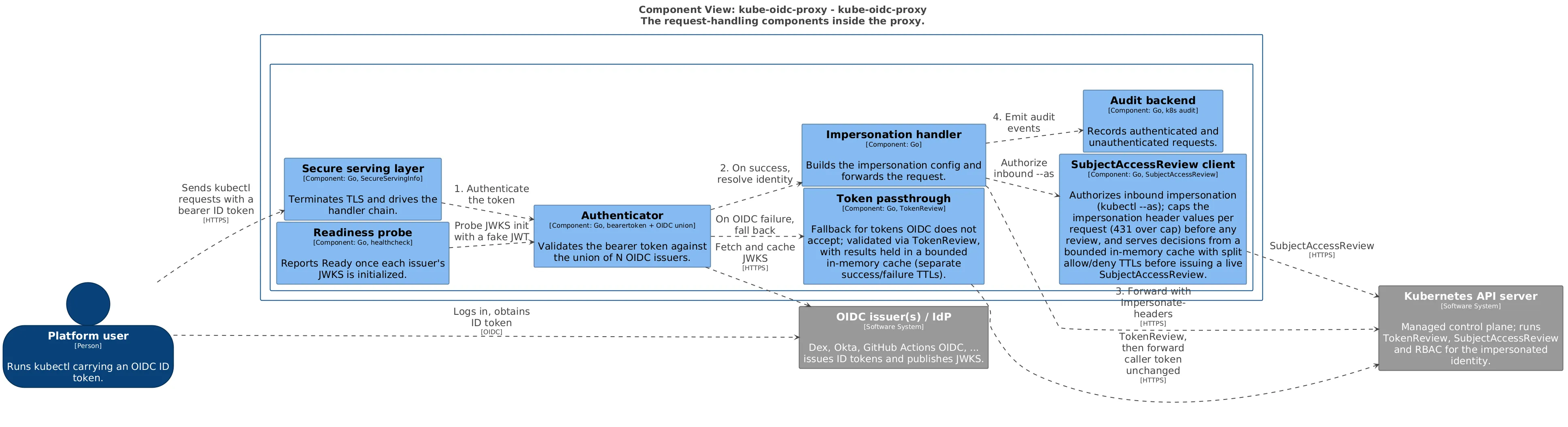
Section titled “Handler-chain components (C4 level 3)”A structural view of the serving layer’s handler chain, wrapped in execution
order authenticate then impersonate then audit then reverse proxy. Each stage
maps to a handler in pkg/proxy.
Metrics data flow
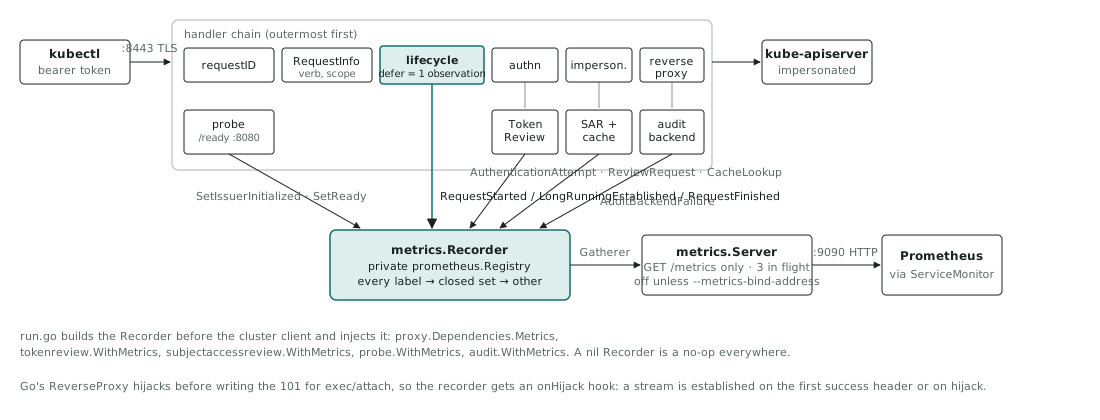
Section titled “Metrics data flow”Where the optional Prometheus metrics attach to the components above: one observation point in the handler chain, every collaborator reporting to one injected recorder, served by its own listener. Hand-authored, not part of the Structurizr model; the operator view is in the metrics reference.